By Operon Editorial
February 12, 2026 - 7 min read
At a Glance
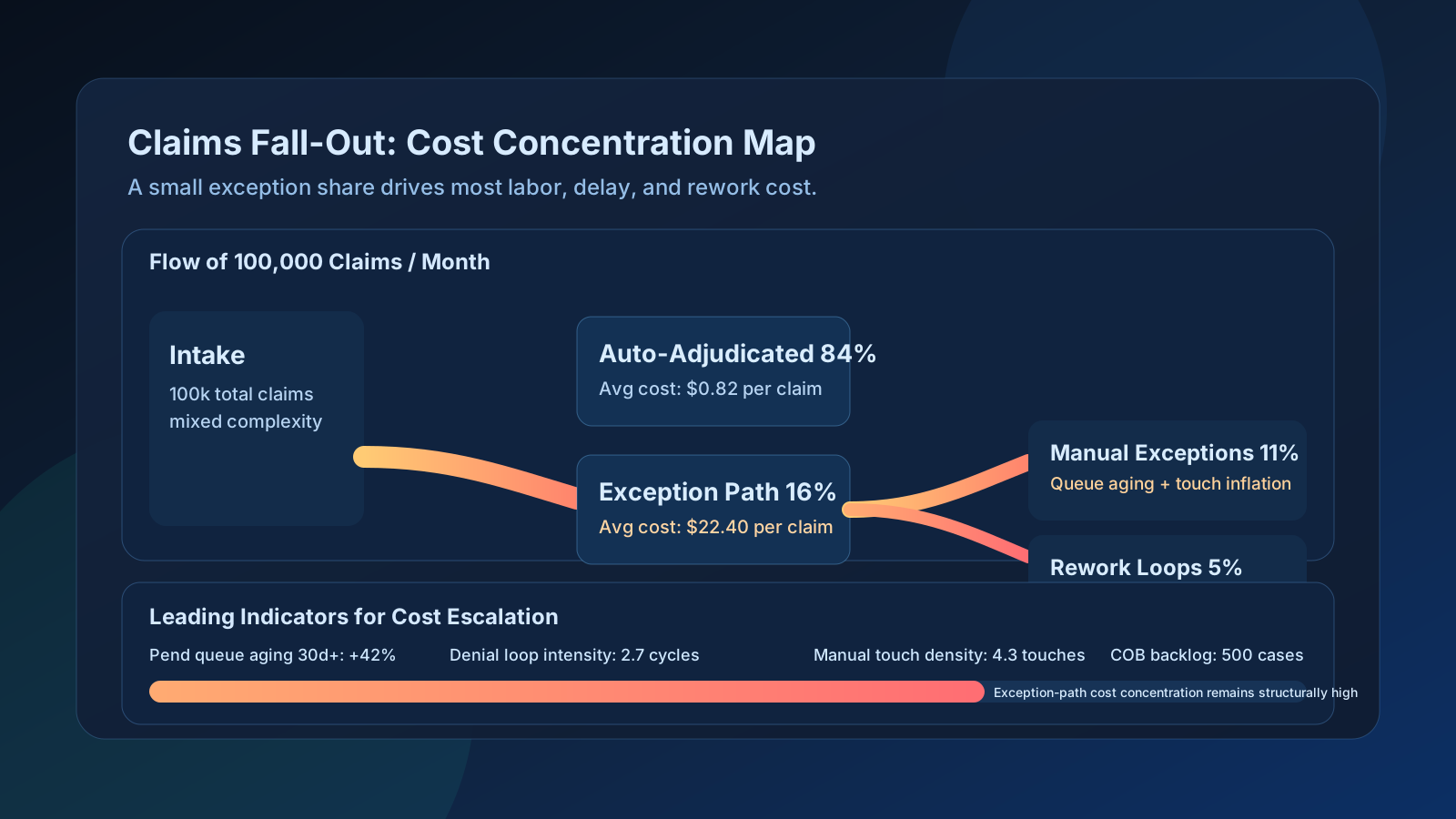
Most claims organizations track auto-adjudication rate as a core KPI. It is useful, but incomplete. The real operational and financial burden sits in the non-auto path: exceptions that enter manual queues, accumulate pend time, loop through rework, and consume higher-cost resources. Many plans can report outcomes such as paid, denied, and adjusted, yet cannot reliably explain how specific claims moved through work queues, how many touches occurred, or what each path actually cost. That gap is not a reporting failure. It is a data-layer failure. Exception economics require case-level workflow telemetry, not only claims outcome analytics.
The Happy Path Illusion
Auto-adjudication rate can create false confidence because it measures what did not need intervention. Leadership may see a strong percentage and assume processing efficiency is under control while exception burden grows in parallel.
In practice, even small percentage shifts can move large claim volumes into manual handling. When those volumes are measured only in aggregate, organizations miss where cost concentration forms: specific pend reasons, provider cohorts, benefit configurations, or handoff bottlenecks.
The KPI is not wrong. It is simply one-sided. Health plans need a paired exception view that captures where the remaining work goes and how expensive each path becomes.
Why Fall-Out Becomes a Black Box
When a claim falls out of auto-adjudication, it enters a dynamic process with multiple potential branches: pends, document requests, clinical validation, denial review, and resubmission loops. Each branch has different labor intensity and elapsed time behavior.
Most enterprise reporting stacks are optimized for final claim outcomes and financial reconciliation, not for operational path reconstruction. That means teams can identify what happened at the end, but not necessarily why the workflow consumed so much effort on the way there.
Without path-level instrumentation, root cause analysis defaults to anecdote. Teams know exceptions are expensive, but cannot consistently rank the exact drivers by volume, delay contribution, and cost impact.
Pend Aging Is a Leading Indicator, Not a Backlog Metric
Pend queues are often reviewed through weekly extracts, which creates lag in both detection and response. By the time aging spikes are visible in a report, the queue may already have exceeded recovery capacity without temporary staffing or process intervention.
Different pend reasons behave differently. Some should resolve quickly, others have legitimate extended timelines. Aggregating them into one aging number obscures where operational risk is forming. Teams need reason-level trend visibility with thresholds tied to expected resolution behavior.
When pend monitoring becomes real-time and segmented, supervisors can redirect work before backlog turns into breach. That shift alone can reduce avoidable delay and emergency cleanup cycles.
The Rework Tax Is Usually Underestimated
Rework loops are expensive because they multiply touches across the same case. Each loop can include additional review, correspondence, reassignment, and adjudication overhead. Yet many dashboards still treat denial and eventual resolution as a single event pair.
That view misses cumulative labor impact. A case that loops three times may appear as one denial and one payment in outcome systems while consuming significant internal and vendor capacity across multiple stages.
To control rework, plans need loop visibility by stage, reason, and owner type. Once loop patterns are visible, teams can target policy edits, automation rules, and training interventions where they reduce total cost most effectively.
Why Unit Economics Stay Elusive
CFO and operations leaders eventually ask for cost per claim by type, by resource mix, and by automation level. Many organizations still answer with periodic spreadsheet studies that require manual joins across systems and assumptions that are difficult to validate later.
Those studies are often directionally useful but operationally stale by the time they are delivered. They are hard to repeat at high frequency and hard to tie back to live staffing, outsourcing, and automation decisions.
Reliable unit economics require continuous case-level cost modeling from workflow data: touches, stage dwell, resource type, and rework contribution. Without that layer, major decisions remain under-instrumented.
About Operon.Cloud
Operon.Cloud helps payer operations teams expose claims workflow behavior beyond final outcomes, including exception flow, pend dynamics, rework patterns, and case-level cost signals.
The platform creates a unified operational view from existing workflow systems so teams can measure and improve exception economics in near real time.
See what claims processing visibility looks like in practice: /solutions/claims-processing