By Operon Editorial
March 12, 2026 - 7 min read
At a Glance
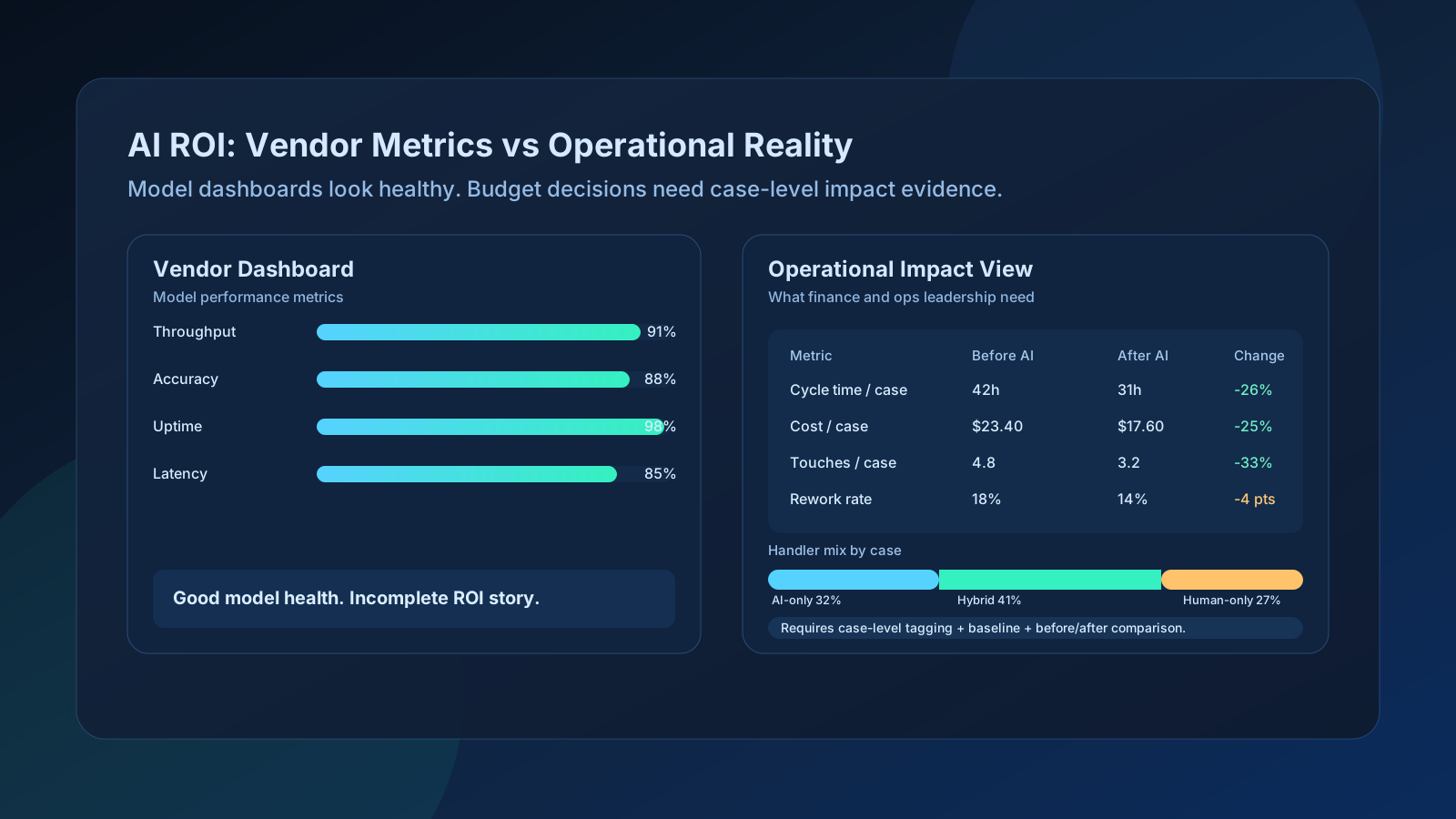
AI adoption in payer operations has accelerated across prior authorization, claims triage, coding support, and member service workflows. Yet when budget cycles arrive, many organizations still struggle to defend AI expansion with hard evidence. The root cause is not weak models. It is weak measurement design. Vendor dashboards report model throughput, latency, and accuracy. Executive teams need to know whether operations actually improved: lower cost per case, faster turnaround, fewer touches, lower rework, and better SLA performance. Those are operational outcomes that can only be measured from the plan's own workflow data, with case-level attribution and a clear baseline.
The 94 Percent / 5 Percent Reality
Across the market, AI pilots are now common and production deployments are no longer unusual. But confidence in ROI remains uneven. Many leadership teams can show activity metrics and adoption narratives but cannot show durable operational delta by workflow, handler type, and period.
This creates a repeat pattern: initial enthusiasm, short-term pilot wins, then budget scrutiny with weak attribution. Teams respond with estimates because clean before-versus-after comparisons are unavailable. Programs remain in pilot scope longer than expected, not because stakeholders reject AI, but because proof quality is too soft for scaling decisions.
The organizations that break this cycle treat ROI as an operations analytics problem from day one. They define required signals before rollout, then instrument workflows so impact can be defended with internal evidence.
What Vendor Dashboards Actually Measure
Vendor dashboards are useful for technical quality. They track model-level behavior: request volume, response times, confidence patterns, uptime, and sometimes estimated time savings. These metrics are necessary for service reliability and vendor management.
They are not sufficient for financial accountability. A fast, accurate model can still fail to improve end-to-end operations if handoffs remain slow, exception rates stay high, or human validation loops absorb most potential gains. In those cases, model quality and business value diverge.
This is why a single source of truth from the vendor side is structurally incomplete. The vendor sees model events. The plan sees workflow outcomes. ROI requires both, joined at the case level, with clear attribution rules.
The Tagging Gap
Most workflow systems do not consistently tag each case stage by handler type. A case touched by AI, a case completed by human reviewers, and a hybrid case often look similar in operational reporting. Without explicit attribution, downstream metrics are ambiguous.
Handler tagging is the first control point for credible measurement. At minimum, teams need structured labels that persist through each stage: AI-only, human-only, and hybrid. They also need timestamps and ownership context so analysts can distinguish productive automation from deferred manual work.
Without this foundation, adoption percentages, productivity claims, and savings figures become approximation exercises. With it, every metric becomes testable against real workflow behavior.
The Baseline Gap
Even with clean tagging, there is no ROI without a baseline. Many plans began AI programs before capturing consistent pre-AI metrics for cycle time, touch count, rework frequency, and fully loaded cost by case type. That makes direct comparison difficult when leadership asks for impact evidence.
Teams can still recover. Historical workflow data can be reconstructed to estimate baseline cohorts, and current instrumentation can create prospective baselines for ongoing measurement. The key is transparency: define methods, assumptions, and confidence bands so decision makers can evaluate quality, not just outcomes.
Baseline discipline also improves vendor conversations. Instead of debating generalized value claims, teams can compare AI-assisted cohorts with matched historical and concurrent controls, then adjust deployment strategy based on observed results.
Escaping the Pilot Trap
The pilot trap is a measurement trap. No tagging means no attribution. No baseline means no comparison. No comparison means no trusted ROI narrative. The result is repeated pilot extensions with limited scale approval.
Breaking out requires an operational measurement stack that is independent, case-level, and continuously updated. Once that exists, AI conversations shift from belief to evidence: where AI outperforms, where it needs human augmentation, and where process redesign is required to unlock gains.
That shift improves governance too. Teams can monitor fairness and model drift in the AI stack while separately proving operational outcomes in the workflow stack. Both layers matter, but they answer different questions for different stakeholders.
About Operon.Cloud
Operon.Cloud provides an operational visibility layer for payer workflows, including handler tagging, baseline analytics, and case-level impact tracking.
By joining workflow telemetry with AI attribution, plans can measure cost, cycle time, touch patterns, and rework outcomes from their own data and use those signals to support scale decisions.
See how health plans prove AI impact from their own workflow data: /solutions/ai-impact-measurement