By Operon Editorial
October 30, 2025 • 6 min read
At a Glance
Healthcare doesn’t have a data problem — it has a trust problem. Years of API enablement and FHIR mandates have accelerated information exchange, yet when a claim or prior authorization diverges, every stakeholder asks the same question: whose version is correct?
Connectivity lets systems talk; trust lets them believe what they hear. Until each transaction carries verifiable proof, interoperability remains a high-speed exchange of uncertainty.
The Hidden Problem: No Shared Proof of Agreement
Payer and provider integrations often behave like sophisticated email. Data is sent, received, and assumed correct — but there’s no neutral audit trail. When statuses conflict or fields mutate, teams reconcile screenshots and exports instead of referencing shared evidence.
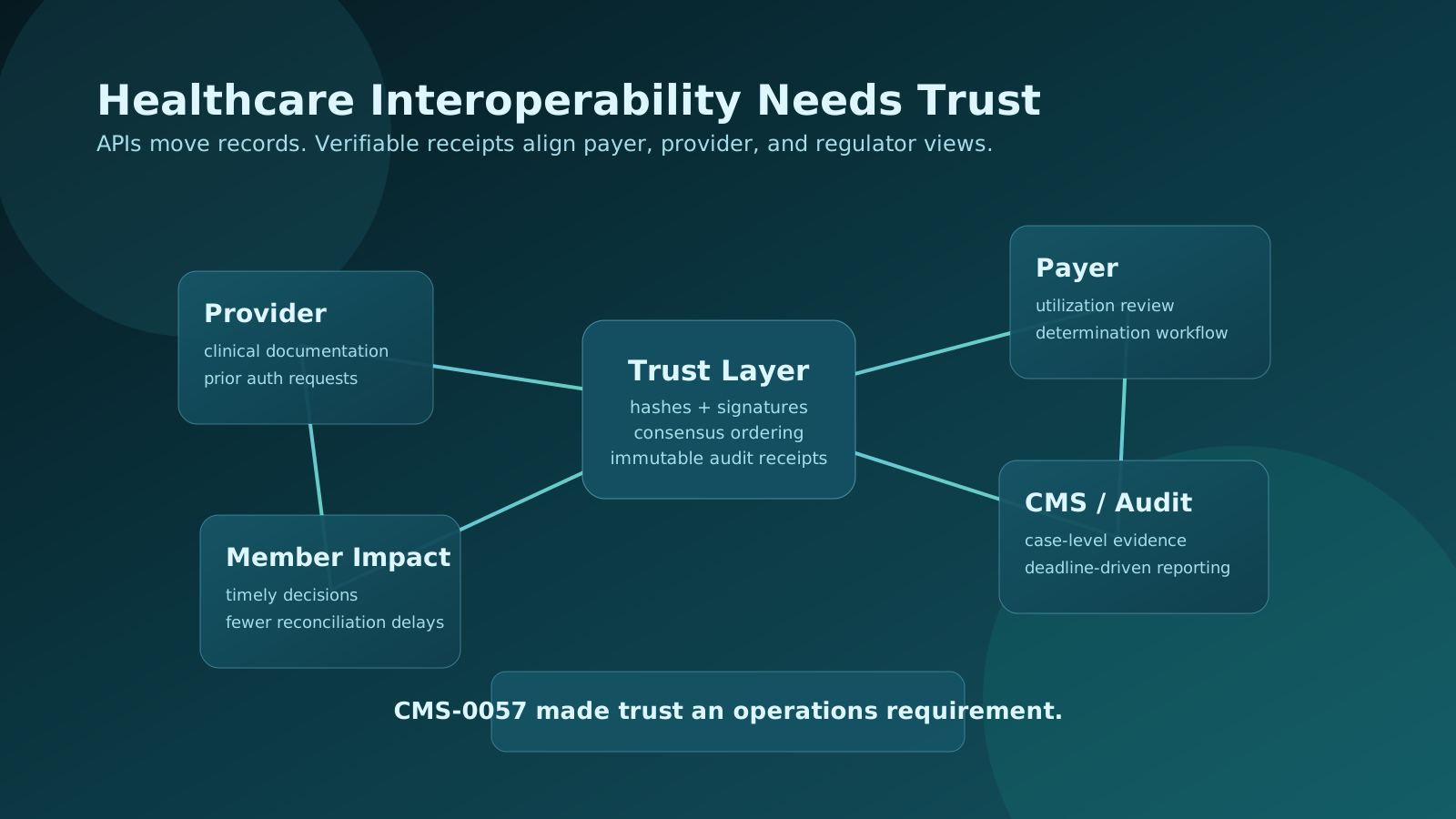
FHIR standardizes format, not fidelity. A verifiable trust layer adds cryptographically signed, time-stamped receipts to every event, ensuring all parties reference the same immutable record.
Why CMS-0057 Makes Trust a Compliance Priority
CMS-0057 mandates standardized APIs for CRD, DTR, and PAS. Compliance unlocks connectivity, but accountability still hinges on evidence. Each exchange should emit a verifiable artifact confirming who originated the data, when, and under what policy context. Such artifacts turn compliance from a reporting exercise into a built-in system property.
From Connectivity to Cryptographic Assurance
Closing the trust gap doesn’t require public blockchains or tokens. Permissioned consensus and modern cryptography deliver tamper-evident timelines:
- Digital signatures authenticate participants and preserve data integrity.
- Hashing fingerprints payloads without exposing PHI.
- Decentralized identifiers (DIDs) establish verifiable organizational identities.
- Consensus ordering guarantees every system observes the same sequence of events.
Together, these techniques form the foundation for verifiable, audit-ready interoperability.
Value-Based Care Runs on Verifiable Truth
Shared truth is the foundation of value-based care. Attribution, quality measures, and utilization metrics collapse when stakeholders dispute data lineage. Verifiable proofs replace debates with reconciliation grounded in cryptographic evidence — ensuring every participant references the same event, version, and timestamp.
Permissioned Consensus: Governance Meets Integrity
Public ledgers proved the math; healthcare needs a governed version. Permissioned consensus networks deliver private membership, predictable cost, and seamless integration with existing FHIR and cloud ecosystems. Operon.Cloud implements this through Hedera Hashgraph on a cloud-native architecture — no miners, no tokens, just verifiable trust.
Compliance That Proves Itself
- Audits become continuous. Every API call carries its own compliance artifact.
- Reconciliation collapses. Shared receipts resolve “who changed what” in seconds.
- Automation accelerates. Builders can orchestrate workflows on verified data.
- Accountability scales. Each participant can prove — not claim — what occurred.
From Connectivity to Confidence
CMS-0057 and value-based care are pushing healthcare toward openness. But openness without verifiability multiplies risk. Trust — cryptographically verifiable, continuously auditable, and governed by shared standards — turns interoperability into confidence.
About Operon.Cloud
Operon.Cloud delivers a cloud-native, permissioned blockchain infrastructure that brings verifiable trust to healthcare interoperability.
Our platform acts as a consensus and audit layer across enterprise systems, enabling organizations to exchange data with proof, privacy, and policy control — without disrupting existing workflows.
Built for compliance and scalability, Operon.Cloud transforms digital collaboration into digital trust.