By Operon Editorial
February 26, 2026 - 7 min read
At a Glance
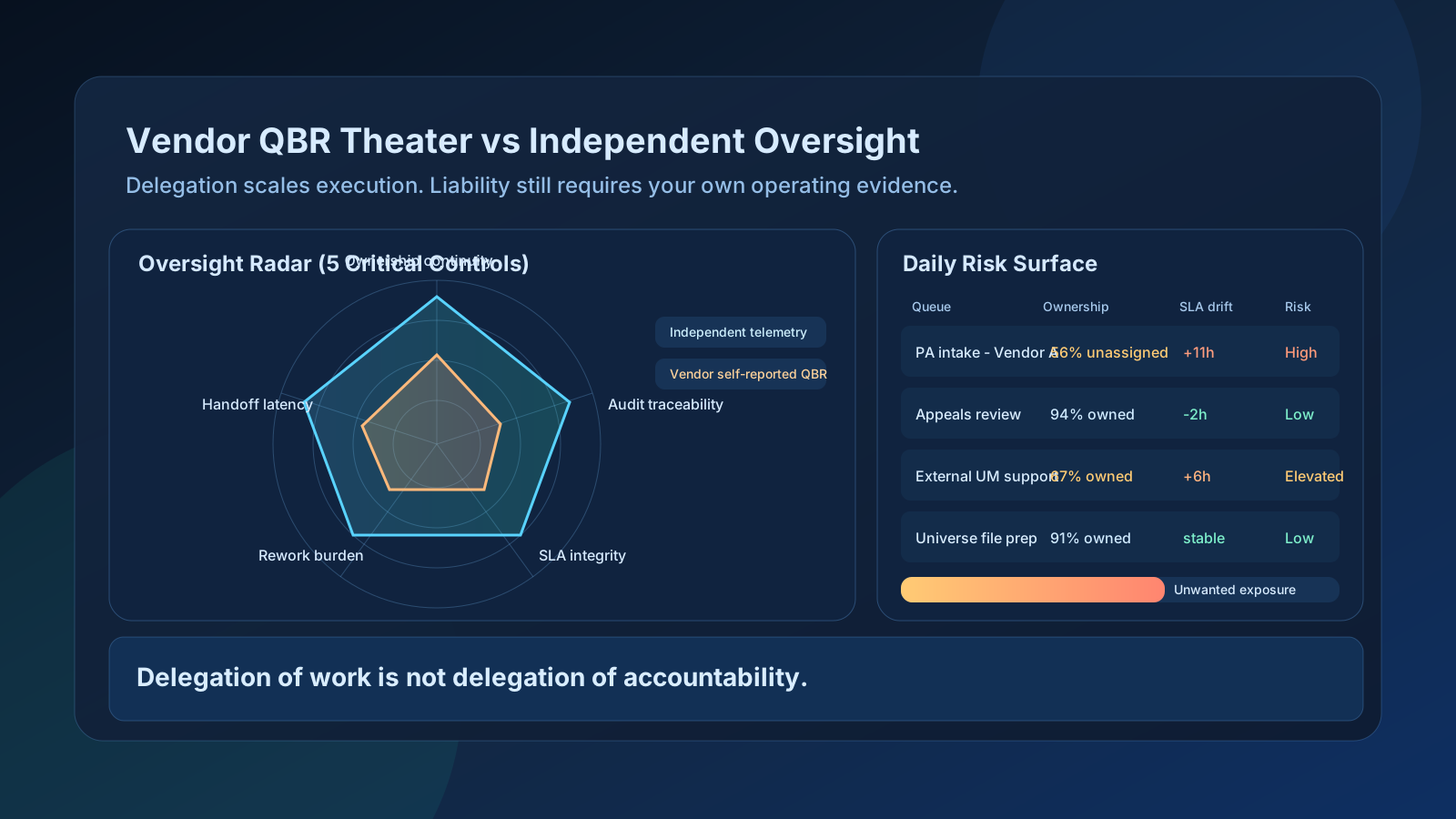
Health plans routinely delegate utilization management, prior authorization operations, and claims workflows to specialized vendors. But delegation of execution does not remove plan liability. Under Medicare Advantage oversight expectations, organizations remain accountable for first-tier, downstream, and related entities. In practice, many plans still evaluate delegated performance through quarterly business reviews built from vendor-selected metrics and vendor-controlled data. This creates a structural blind spot: the same party being measured controls the measurement framework. Independent oversight requires case-level telemetry from the plan's own operational view, including ownership continuity, rework burden, and stage-level SLA behavior.
The Delegation Paradox
Delegation exists for good reasons: scale, specialization, and variable capacity. Vendors can provide throughput where internal teams are constrained. But risk ownership remains with the plan, especially in regulated lines of business where member outcomes and timeliness obligations are explicit.
That mismatch between responsibility and visibility is the core paradox. Plans are accountable for outcomes they often cannot independently observe in detail. By the time exceptions appear in summary dashboards, remediation windows may already be closing.
A delegated model can be effective, but only if performance evidence is independent, current, and granular enough to support intervention before breaches compound.
What QBRs Capture - and What They Miss
Traditional QBRs summarize volume, high-level turnaround, and SLA percentages. They are useful for strategic discussion, relationship management, and trend communication. They are not designed for forensic operational truth.
What is often missing is the path of work: who owned each case at each stage, where handoffs stalled, which loops added delay, and how much rework burden was created downstream. A vendor can report strong aggregate compliance while still generating localized risk through unassigned queues, delayed pickups, or repeated re-entry patterns.
Without path-level context, leadership may optimize for top-line percentages while hidden cost and compliance exposure grow inside the workflow.
The Ownership Gap Is Operational Risk
One recurring failure pattern is the unassigned lane: cases that are technically active but not clearly owned at the current stage. In delegated environments, ownership can become ambiguous at boundaries between teams, systems, or process steps. Those cases tend to age silently.
From a control perspective, unowned work is high-risk work. No accountable handler means no active clock management, no proactive escalation, and weak root-cause learning. This is exactly the type of risk that aggregate QBR narratives can miss.
Independent oversight must therefore include live ownership state as a primary metric, not an afterthought. If ownership continuity is unstable, SLA performance and member experience will eventually follow.
Audit Readiness Requires Independent Data
When plans receive audit notices, response windows are short and expectations for documentation quality are high. Teams relying on vendor-originated aggregates often enter an emergency reconciliation cycle: request data, align definitions, resolve discrepancies, and reconstruct case-level history under deadline pressure.
Plans with independent operational data avoid that cycle. They can query case-level records directly, segment by vendor and workflow stage, and produce documentation that stands on its own. This reduces execution risk and improves confidence during audit interactions.
The key is not replacing QBRs. It is supplementing them with an internal scorecard that is continuously updated and independently derived.
From QBR Theater to Operational Truth
Mature oversight models compare delegated and internal performance on equivalent work using shared definitions. They track throughput, pickup latency, touch density, rework incidence, and ownership stability. They also map cost impact by workflow segment so contract decisions can be tied to measurable outcomes.
This enables better decisions across insource-versus-outsource strategy, staffing allocation, and performance remediation. Vendor relationships improve when expectations are grounded in transparent, comparable evidence.
QBRs remain useful communication tools. But oversight becomes real only when the plan can verify delegated performance independently, at the case level, on demand.
About Operon.Cloud
Operon.Cloud gives health plans a unified operational visibility layer across internal and delegated workflows.
The platform supports independent vendor scorecarding with case-level telemetry, ownership tracking, SLA performance analysis, and rework quantification from the plan's own operational data sources.
See what independent vendor scorecarding looks like in practice: /solutions/vendor-performance